
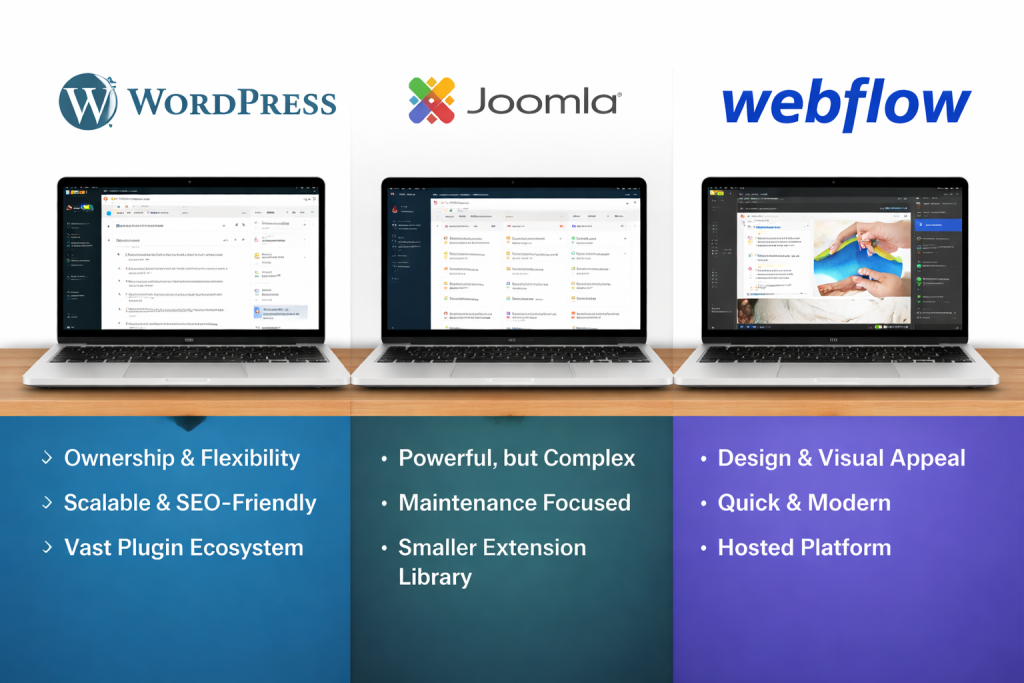
WordPress, Joomla and Webflow all build websites, but they come from completely different philosophies. WordPress is built for flexibility and scale. It’s an ecosystem rather than just a platform. You can run a simple blog, a complex business website, an ecommerce store, a membership portal or an entire learning platform on it. Its strength is adaptability and ownership. You control your hosting, your data, your structure and your growth. That’s why it still powers the majority of the web and why it remains the most future-proof option for businesses that want long-term control.
Joomla sits in an awkward middle space. It’s more complex than WordPress for everyday users, but without the same ecosystem, plugin depth or developer adoption. It can be powerful in the right hands, but it’s less intuitive, harder to maintain, and increasingly less supported by modern marketing tools. Most businesses don’t choose Joomla today unless they are maintaining a legacy system. It works, but it rarely excites, and it doesn’t integrate as naturally into modern content, SEO and automation strategies.
Webflow is a different proposition entirely. It’s design-led. Beautiful, smooth, fast and visually impressive. For brochure sites and brand-led launches, it can feel incredibly clean and refined. But Webflow is not open infrastructure in the same way WordPress is. You don’t truly own the hosting environment, you are tied into their ecosystem, and costs rise as your site grows. It’s excellent for designers and startups that value visual control, but it can become restrictive when businesses need deeper integrations, advanced SEO control, large-scale content systems or complex automation.
The real difference isn’t technical. It’s philosophical. WordPress is ownership. Joomla is maintenance. Webflow is presentation.
WordPress supports compound content, long-term SEO, authority building and digital ecosystems. It grows with your business. Joomla keeps systems running. Webflow makes things look beautiful fast.
In a world moving toward compound content, Emotional SEO, and digital assets that compound in value, the platform you choose matters. You’re not just choosing how your site looks. You’re choosing how much control, scalability and future flexibility your business will have.